Sliding vs Hinged Wardrobe in Jaipur — Which Fits Your Home?
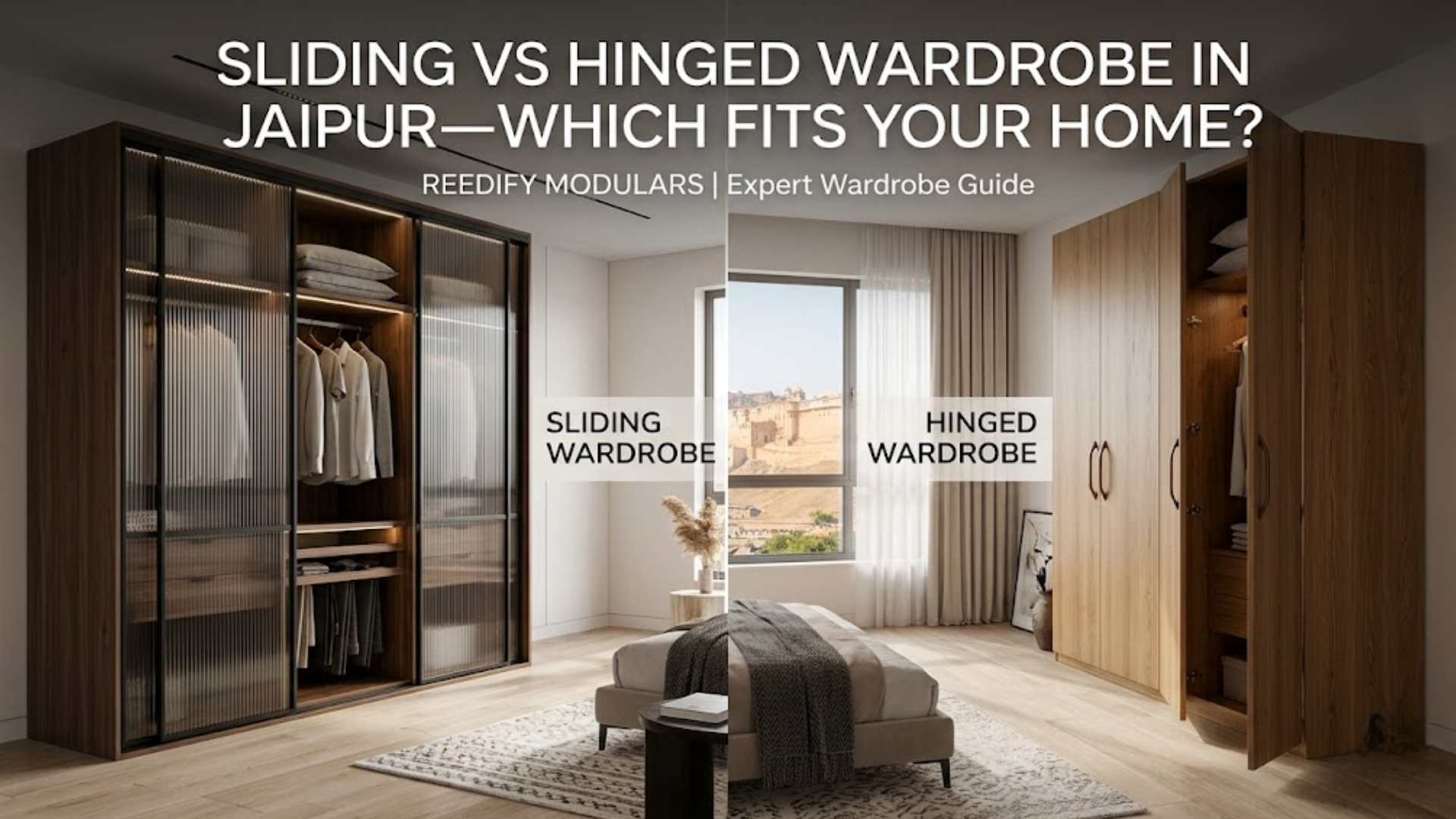
Sliding Door or Hinged Door Wardrobe for Your Jaipur Home — The Answer Nobody Gives You Straight
Every Jaipur homeowner furnishing a bedroom eventually lands on this question. You have seen both types. You have a vague preference. But the more you search, the more you find generic answers that tell you both types are great and ultimately recommend whatever the vendor wants to sell you.
This guide does something different. It gives you a framework specific to Jaipur homes — your apartment size, your bedroom layout, your family's wardrobe habits, and Rajasthan's climate — to make this decision with complete confidence.
Reedify Modulars manufactures both sliding and hinged wardrobes across Jaipur and the full NCR belt, with factory-precision builds and a 10-year documented warranty on every wardrobe they deliver. Their design team makes this exact recommendation for Jaipur homeowners every single day — and by the end of this guide, you will be able to make it yourself.
Why This Decision Matters More Than Most Wardrobe Choices
Most wardrobe decisions — finish color, handle style, internal fitting layout — can be revisited and changed over time without significant cost. The sliding versus hinged decision cannot. It determines the structural design of the entire wardrobe: the shutter panel system, the hardware track, the carcass depth, and ultimately how your bedroom feels and functions every morning for the next decade.
Getting it wrong has real daily consequences. A hinged wardrobe in a bedroom too tight to accommodate the door swing means you are stepping around an open door every time you access your wardrobe. A sliding wardrobe in a context where you need simultaneous full-width access means you are always moving panels aside and losing visibility of half your wardrobe contents at any given moment.
Neither type is universally better. The right answer depends on five factors specific to your Jaipur home — and this guide walks through every one of them.
Factor 1 — Your Bedroom Size and Layout
This is the most important factor and the one that most definitively resolves the debate for the majority of Jaipur homeowners.
Jaipur's residential apartment market — particularly the large inventory of 2BHK and 3BHK flats across Mansarovar Extension, Jagatpura, Pratap Nagar, Sitapura residential zones, and newer developments along Ajmer Road and Sirsi Road — typically delivers master bedrooms between 120 and 160 square feet. In this size range, the bed placement almost always puts the foot of the bed 3 to 4.5 feet from the wardrobe wall. This is where the decision gets made.
A hinged wardrobe door on a standard 24-inch deep wardrobe swings out 24 inches — 2 full feet — into the bedroom when opened. That means you need a minimum of 2 feet of clear floor space in front of the wardrobe before you account for standing room to actually access the wardrobe contents. In practice, comfortable hinged wardrobe access requires 3 to 3.5 feet of clear space between the wardrobe front and the nearest obstruction.
If your bed-to-wardrobe distance in your Jaipur bedroom is less than 4 feet — which is true for most 2BHK layouts in Mansarovar, Vaishali Nagar, and Jagatpura — a hinged wardrobe is working against your bedroom's usable space every time it is opened.
A sliding wardrobe needs zero clearance in front. The panels move laterally along a top and bottom track. You can stand directly against the wardrobe front and slide the panel open without the door encroaching on any surrounding space. For the majority of Jaipur's 2BHK and compact 3BHK apartments, sliding wardrobes are the functionally superior choice purely based on this spatial reality.
The case for hinged wardrobes becomes stronger in larger master bedrooms — independent houses in Civil Lines, Bani Park, Jawahar Nagar, or Shyam Nagar where room dimensions are generous enough that the door swing is never a practical issue. In a 200-square-foot master bedroom with a bed-to-wardrobe distance of 6 feet or more, the hinged wardrobe restriction disappears entirely.
Factor 2 — How Your Household Actually Uses the Wardrobe
Usage pattern is the second decisive factor — and it is entirely missed by generic national guides that treat all wardrobe users identically.
Jaipur's household wardrobe culture has a specific characteristic that differs from metros: a significantly higher volume of occasion and festive wear. A typical Jaipur household maintains a larger inventory of formal clothing — sarees, lehengas, sherwanis, suits — than the average Indian metro household. This clothing requires full-length hanging and is accessed less frequently but demands complete visibility and reach when needed.
For households with significant occasion wear, the hinged wardrobe has a genuine functional advantage. When both doors open fully, you have complete, simultaneous visibility and access to the entire wardrobe width. Selecting a specific saree from a collection of twenty or finding a specific sherwani is dramatically easier when you can see everything at once.
Sliding wardrobes always have one panel covering approximately half the interior width. For daily-wear retrieval — reaching for the shirt in your regular section or pulling from your regular shelf — this is no inconvenience. For navigating a large collection of occasion wear where you need to compare and select, it adds friction.
The practical solution Reedify designs for Jaipur households with significant occasion wear: a sliding wardrobe with a three-panel system rather than the standard two-panel. A three-panel sliding wardrobe allows any section of the interior to be accessed by moving only one panel, and in a wider layout — 8 feet or more — two-thirds of the interior is visible simultaneously. This gives the access advantages of a hinged wardrobe within the spatial footprint of a sliding one.
Factor 3 — The Visual Impact You Want the Wardrobe to Make
Beyond function, the sliding versus hinged decision has significant aesthetic implications — and in Jaipur's increasingly design-conscious residential market, this matters.
Sliding wardrobes in 2026 offer panel finish options that hinged wardrobes cannot easily replicate. A floor-to-ceiling sliding wardrobe with mirror-front panels is the most powerful visual intervention available in a bedroom. Mirror panels across an 8 or 10-foot wardrobe width visually double the apparent room size — a meaningful advantage in compact Jaipur apartments where the master bedroom serves as the primary space for both sleeping and dressing.
Glass-front sliding panels — clear, frosted, bronze, or back-painted — create a contemporary aesthetic that works exceptionally well in Jaipur's newer apartment typology in Jagatpura, Pratap Nagar, and Mahindra SEZ residential zones. Fluted glass panels, which are the dominant premium wardrobe design trend in 2026, are almost exclusively executed on sliding wardrobes because the lateral panel format shows the fluted texture at its full visual impact.
Hinged wardrobes offer more flexibility in shutter profile design — frame-and-panel profiles, router-carved detailing, and traditional Rajasthani-inspired jaali (lattice) insert panels are all achievable on hinged doors in ways that sliding panels cannot accommodate. For homeowners in Civil Lines, C-Scheme, and Bani Park who want wardrobe designs that connect to Rajasthani architectural tradition rather than metropolitan contemporary, hinged wardrobes are the appropriate canvas.
Reedify's design team works with both configurations at equal competency. During your 3D design presentation — delivered within 48 hours of the free site visit — you see exactly how both options would look in your actual bedroom before committing to either.
Factor 4 — Maintenance and Longevity in Jaipur's Climate
Rajasthan's semi-arid climate creates specific maintenance realities for both wardrobe types — and this is the factor that no national wardrobe guide addresses for Jaipur buyers.
Jaipur's extreme summer dryness — with relative humidity dropping below 20% during May and June — causes wood-based materials to contract. The brief monsoon period brings humidity above 70%. This cycle of contraction and expansion is handled differently by the two wardrobe types.
Hinged wardrobe doors on plywood and solid wood carcasses are more susceptible to seasonal misalignment in Jaipur's climate. A hinged door that is perfectly aligned in December may begin to catch slightly at the top or bottom by May as the wood has contracted and the frame geometry has shifted marginally. Quality piano hinges and cup hinges with three-dimensional adjustment — which Reedify uses as standard — allow post-installation adjustment to compensate for seasonal movement. But this adjustment requires awareness and occasional maintenance attention.
Sliding wardrobes in Jaipur's climate are more self-managing in terms of alignment. The aluminum or steel track system is dimensionally stable regardless of humidity shifts. The panels themselves move within the track rather than being hinged at a fixed point, so minor dimensional changes in the panel wood do not affect door function the way they affect hinged door alignment.
For Jaipur's ground-floor apartments and independent houses that experience more pronounced humidity swings between seasons, sliding wardrobes are the lower-maintenance choice over a 10-year period. For upper-floor apartments in Mansarovar or Jagatpura high-rises with consistent air conditioning, the maintenance difference between the two types is minimal.
Factor 5 — Budget Reality for Each Type in Jaipur
Let us address this directly because vendor transparency on this point is rare in Jaipur's wardrobe market.
Sliding wardrobes at equivalent quality specifications cost more than hinged wardrobes. The difference comes from two components: the aluminum or steel sliding track system, which adds a hardware cost that hinged wardrobes do not have, and the panel construction, which needs to be engineered to run smoothly and quietly under the weight of a full-height panel over years of daily use.
At Reedify Modulars, a standard 8-foot-wide hinged wardrobe in mid-range laminate finish with BWP plywood carcass and Hettich hinges starts from approximately ₹65,000 to ₹85,000 for a Jaipur installation. The equivalent sliding wardrobe with an aluminum track system and laminate panels starts from ₹85,000 to ₹1.1 lakh. The price difference is real — roughly 20 to 35% more for sliding at equivalent quality levels.
Where sliding wardrobes close the value gap is on the visual premium they deliver. Mirror-front and glass-front sliding panels create a visual transformation in the bedroom that hinged wardrobes at any price point cannot replicate. For homeowners where the bedroom aesthetic matters as much as the storage function, the sliding wardrobe premium represents genuine value.
For buyers with a strict budget constraint who need maximum storage per rupee spent, a well-designed hinged wardrobe from Reedify with a full interior configuration — organized shelves, pull-out sections, shoe rack, and integrated loft — delivers more storage organization per rupee than a sliding wardrobe at the same spend.
The Decision Framework — What Reedify's Design Team Actually Recommends
After thousands of wardrobe installations across Jaipur and NCR, here is the pattern Reedify's design team sees consistently.
Choose a sliding wardrobe if: your bed-to-wardrobe distance is under 4 feet, your bedroom is under 150 square feet, you want mirror or glass front panels, you are in a newer Jaipur apartment in Jagatpura or Pratap Nagar with a contemporary interior, or you want a low-maintenance solution in a ground-floor home with humidity exposure.
Choose a hinged wardrobe if: your bedroom is generously sized with 5 feet or more of clear space in front of the wardrobe wall, you have a large occasion wear collection that benefits from full simultaneous access, you prefer traditiona
l or frame-and-panel shutter designs, or your budget is tighter and you want maximum storage per rupee.
Choose a three-panel sliding wardrobe if: you have a wardrobe wall 8 feet wide or wider, want the spatial benefits of sliding with better interior visibility than standard two-panel, and are willing to invest in the premium hardware that a three-panel system requires.
The honest truth is that this decision has a clear right answer for most Jaipur homes — and Reedify's designer identifies it within the first 10 minutes of the free home visit based on your actual bedroom measurements and usage discussion.
Frequently Asked Questions — Sliding vs Hinged Wardrobe in Jaipur
Can I get a mirror-front option on both sliding and hinged wardrobes?
Mirror fronts are standard on sliding wardrobes. For hinged wardrobes, a full-length mirror is typically incorporated as a separate panel on the inside of a door or as a standalone dressing mirror, rather than as the shutter face — because the mirror weight on a hinged door adds stress to the hinge over time. Reedify designs mirror integration correctly for both configurations.
Do sliding wardrobes collect more dust in Jaipur's environment?
Jaipur's dust levels — higher than coastal cities due to the semi-arid environment and ongoing construction across the city — affect both wardrobe types. Sliding wardrobes with floor tracks can accumulate dust in the track channel. Reedify installs brush seals on sliding tracks for Jaipur installations to reduce this. Top-hung sliding systems — where the panel hangs from an overhead track with no floor track — eliminate the floor dust accumulation entirely and are available as an upgrade.
What is the minimum wardrobe width for a sliding door system to work smoothly?
Sliding wardrobes function best at a minimum width of 5 feet — below that, the panel overlap in a two-panel system reduces interior access significantly. For widths under 5 feet, a hinged wardrobe or a single-panel sliding wardrobe with a fixed section is a better design choice. Reedify's designer assesses your available wall width and recommends accordingly.
How long does a sliding wardrobe track last with daily use in Jaipur?
Premium aluminum track systems from brands like Hettich or Dorma — which Reedify uses as standard — are rated for over 100,000 open-close cycles. At 10 opens per day per panel, that is 27 years of daily use before the track mechanics reach their design life. Economy tracks from unnamed brands at ₹80 per meter fail significantly earlier. Hardware quality is where the price difference between ₹800 per sq ft and ₹1,200 per sq ft wardrobes actually lives.
Does Reedify offer wardrobe customization in both sliding and hinged styles for Jaipur homes?
Yes. Every Reedify wardrobe — sliding or hinged — is manufactured to your specific room dimensions, chosen finish, and interior configuration. There are no fixed catalog sizes. Your Jaipur bedroom's exact measurements determine the wardrobe, not the other way around.
Your Wardrobe Decision Deserves Better Than a Guess
The sliding versus hinged question has a right answer for your specific Jaipur bedroom. It is determined by your room dimensions, your family's usage patterns, your design preferences, and your budget — not by which type a vendor happens to have in stock or which delivers better margin.
Reedify Modulars builds both types with equal manufacturing precision — BWP-grade plywood carcasses, named-brand hardware, factory-controlled quality, and the same 10-year documented product warranty regardless of which configuration you choose.
Book your free home at Reedify designer comes to your Jaipur home, measures your bedroom, understands your usage needs, and tells you clearly which wardrobe type will serve your home better. You see the answer in a 3D design within 48 hours. And you only commit when you are completely confident in what you are getting.


Comments
Post a Comment