Modular Kitchen Price in Delhi: What It Actually Costs in 2026
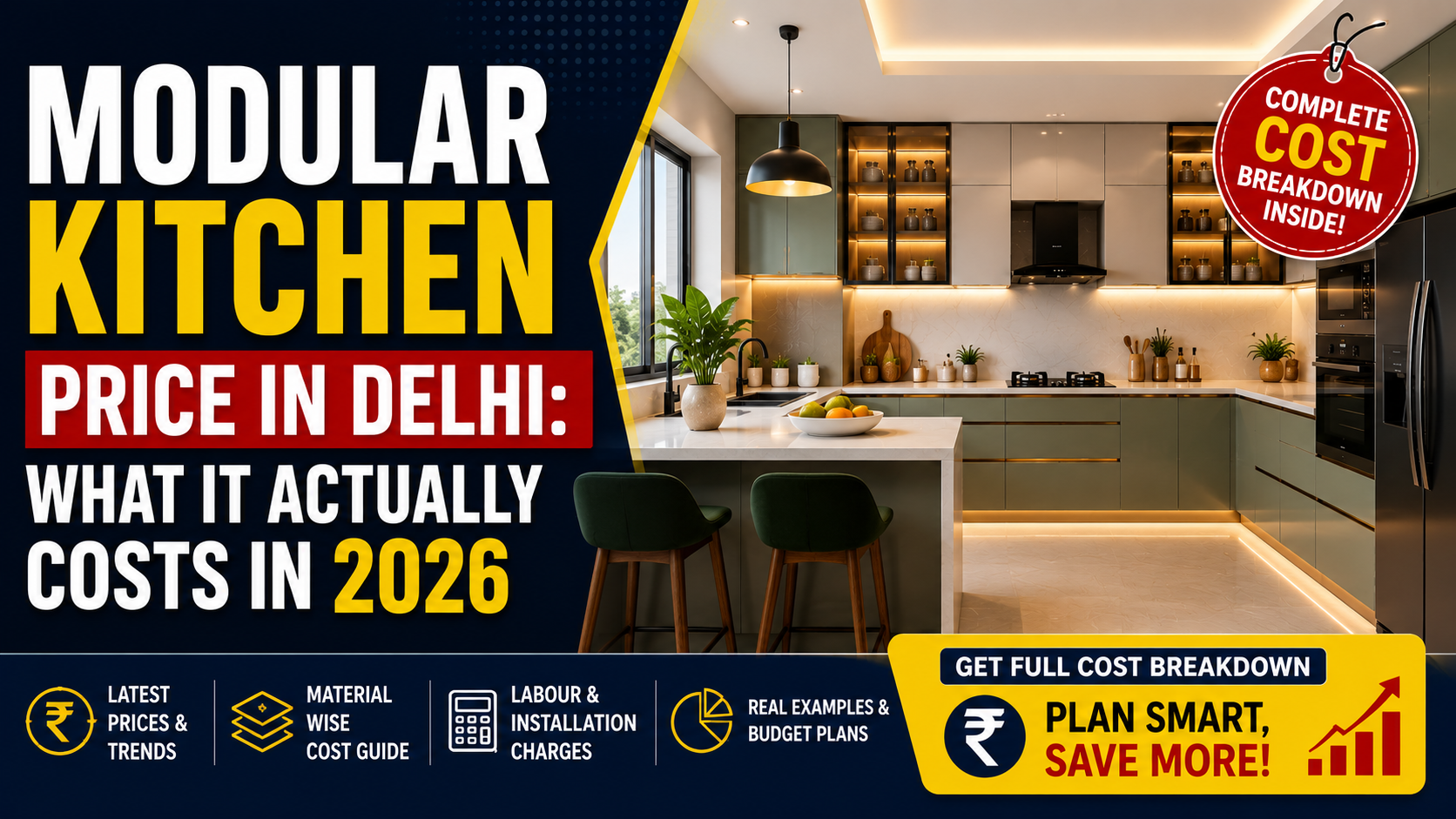
Modular Kitchen Price in Delhi: What It Actually Costs in 2026 (Complete Breakdown)
If you've started researching modular kitchen prices in Delhi, you've probably noticed something frustrating: nobody gives you a straight answer. Every website says "it depends." Every manufacturer quotes a range so wide it's practically meaningless. And the prices you see on aggregator platforms rarely match what you're actually quoted when you walk into a showroom.
This guide fixes that.
We're breaking down modular kitchen costs in Delhi NCR with the level of specificity that actually helps you budget — material by material, layout by layout, component by component. Not vague ranges. Not showroom-inflated numbers. Just practical, real-world pricing based on what homeowners across Delhi, Gurgaon, Noida, Dwarka, Rohtak, and Haryana are actually paying in 2026.
Whether you're furnishing a new flat, renovating an existing kitchen, or comparing quotes from different manufacturers, this guide gives you the knowledge to evaluate pricing intelligently — and avoid overpaying.
Quick Answer: How Much Does a Modular Kitchen Cost in Delhi?
A modular kitchen in Delhi NCR typically costs between ₹1,00,000 and ₹8,00,000 depending on kitchen size, layout, materials, finish, and hardware brand. For a standard 70–100 sq. ft. L-shaped kitchen: budget options start at ₹1–1.5 lakh (laminate finish, HDHMR core), mid-range falls between ₹2–4 lakh (acrylic finish, branded hardware), and premium configurations run ₹4–8 lakh+ (PU paint, imported hardware, integrated appliances). The biggest cost drivers are shutter finish type, hardware brand, and cabinet core material — not just kitchen size.
Understanding How Modular Kitchen Pricing Works
Before we get into specific numbers, you need to understand how modular kitchen manufacturers in Delhi calculate pricing. There are two common models, and knowing which one your manufacturer uses prevents confusion.
Per Square Foot Pricing
Some manufacturers quote per square foot of cabinet area. This means the total area of all cabinet fronts — base cabinets, wall cabinets, tall units — measured in square feet. The rate per square foot varies based on the material and finish you choose.
Typical per sq. ft. rates in Delhi NCR (2026):
| Category | Material + Finish | Price Per Sq. Ft. (Approx.) |
|---|---|---|
| Budget | HDHMR + Laminate | ₹1,200 – ₹1,600 |
| Mid-Range | HDHMR/BWR Ply + Acrylic | ₹1,800 – ₹2,500 |
| Premium | Marine Ply + PU Paint | ₹2,800 – ₹4,000 |
| Luxury | Marine Ply + Italian Finish | ₹4,000 – ₹6,000+ |
Important: Per sq. ft. pricing usually covers the cabinet structure and shutters only. Hardware, countertop, backsplash, chimney, sink, and accessories are billed separately. Always ask for an all-inclusive quote — not just the per sq. ft. rate.
Package or Lump-Sum Pricing
Other manufacturers quote a complete package price based on your kitchen layout and dimensions. This approach is easier to compare across vendors but can hide significant variations in material quality. Two "₹2.5 lakh L-shaped kitchen" quotes might use completely different board grades, hardware brands, and edge banding quality.
Which model is better? Neither inherently. What matters is getting a fully itemized breakdown — regardless of how the headline number is presented. More on this below.
Modular Kitchen Price by Layout in Delhi NCR
Your kitchen layout is the first cost variable because it directly determines how much cabinetry material you need.
Straight Kitchen Price
| Budget Tier | Price Range | What You Get |
|---|---|---|
| Budget | ₹70,000 – ₹1,20,000 | HDHMR + laminate, basic hardware, 7–8 ft. run |
| Mid-Range | ₹1,20,000 – ₹2,00,000 | BWR ply + acrylic, Hettich hardware, tall unit |
| Premium | ₹2,00,000 – ₹3,50,000 | Marine ply + PU, Hafele/Blum, integrated appliances |
Best for kitchens under 50 sq. ft. Minimum cabinet area: approximately 30–45 sq. ft.
L-Shaped Kitchen Price
| Budget Tier | Price Range | What You Get |
|---|---|---|
| Budget | ₹1,20,000 – ₹2,00,000 | HDHMR + laminate, basic soft-close, corner unit |
| Mid-Range | ₹2,00,000 – ₹3,50,000 | HDHMR/BWR + acrylic, Hettich, magic corner, tall unit |
| Premium | ₹3,50,000 – ₹6,00,000+ | Marine ply + PU/acrylic, Hafele, full accessories |
The most common layout in Delhi apartments. Cabinet area: approximately 50–80 sq. ft.
U-Shaped Kitchen Price
| Budget Tier | Price Range | What You Get |
|---|---|---|
| Budget | ₹2,00,000 – ₹3,00,000 | HDHMR + laminate, basic hardware, simple corners |
| Mid-Range | ₹3,00,000 – ₹5,00,000 | BWR ply + acrylic, Hettich/Hafele, tall units, tandem boxes |
| Premium | ₹5,00,000 – ₹8,00,000+ | Marine ply + PU, full Blum, integrated lighting, appliances |
Best for kitchens 100+ sq. ft. Cabinet area: approximately 80–120 sq. ft.
Parallel Kitchen Price
| Budget Tier | Price Range | What You Get |
|---|---|---|
| Budget | ₹1,50,000 – ₹2,50,000 | HDHMR + laminate, standard hardware |
| Mid-Range | ₹2,50,000 – ₹4,00,000 | BWR ply + acrylic, branded hardware, good accessories |
| Premium | ₹4,00,000 – ₹7,00,000+ | Marine ply + PU, premium hardware suite |
Common in older Delhi apartments with narrow rectangular kitchens. Cabinet area: approximately 60–100 sq. ft.
Island Kitchen Price
| Budget Tier | Price Range | What You Get |
|---|---|---|
| Mid-Range | ₹4,00,000 – ₹6,00,000 | L-shape or U-shape + basic island with storage |
| Premium | ₹6,00,000 – ₹12,00,000+ | Full island with breakfast bar, waterfall countertop, premium finishes |
Requires 150+ sq. ft. and is typically seen in luxury apartments, penthouses, and farmhouses in Gurgaon and South Delhi.
Cost Breakdown by Component: Where Your Money Actually Goes
This is the section most price guides skip — and it's the most important. Knowing where your budget goes helps you make intelligent trade-offs rather than just choosing the cheapest overall quote.
1. Cabinet Core Material (25–30% of Total Cost)
The board that forms the structure of your cabinets is the single largest material cost.
| Material | Cost Per Sq. Ft. | Moisture Resistance | Lifespan | Best For |
|---|---|---|---|---|
| Commercial Plywood | ₹45–60 | Low | 3–5 years | Not recommended |
| MDF | ₹40–55 | Very Low | 2–4 years | Not recommended for kitchens |
| HDHMR | ₹55–75 | High | 10–12 years | Budget to mid-range kitchens |
| BWR Plywood | ₹85–120 | High | 15–20 years | Mid-range to premium |
| Marine Plywood | ₹130–170 | Very High | 20+ years | Premium, high-moisture zones |
Our honest recommendation: HDHMR delivers the best value for most Delhi NCR kitchens. It's engineered specifically for moisture resistance, machines beautifully on CNC equipment (clean cuts, precise edges), and costs 35–40% less than equivalent plywood. The one area where plywood genuinely outperforms is the under-sink zone — upgrade that single cabinet to BWR plywood and use HDHMR everywhere else.
2. Shutter Finish (20–25% of Total Cost)
The shutter finish is what you see and touch every day. It's also the biggest factor in how "premium" your kitchen looks.
| Finish | Cost Per Sq. Ft. | Look | Durability | Maintenance |
|---|---|---|---|---|
| Laminate (Matte) | ₹80–150 | Textured, natural feel | Excellent | Very low |
| Laminate (Gloss) | ₹100–180 | Semi-reflective | Very good | Low |
| Acrylic | ₹200–350 | High gloss, mirror-like | Very good | Moderate (fingerprints) |
| PU Paint | ₹350–550 | Smooth, seamless colour | Excellent | Low |
| Membrane/PVC | ₹60–100 | Budget option | Poor (peels in 2–3 years) | Low initially |
| Glass Shutter | ₹400–600 | Transparent, modern | Good (fragile) | Moderate |
What drives the price difference? A 70 sq. ft. L-shaped kitchen with laminate shutters might have a shutter cost of ₹35,000–₹50,000. The same kitchen in acrylic jumps to ₹70,000–₹1,20,000. In PU paint, it's ₹1,20,000–₹1,80,000. That single choice — shutter finish — can swing your total kitchen cost by ₹50,000–₹1,00,000.
Delhi-specific insight: Membrane and PVC shutters are the cheapest option, but Delhi's extreme temperature swings (from 2°C in January to 48°C in June) cause membrane shutters to peel and bubble within 2–3 monsoon seasons. We genuinely cannot recommend them for Delhi NCR homes regardless of budget constraints. Laminate at a slightly higher cost lasts five times longer.
3. Hardware (15–20% of Total Cost)
Hardware includes hinges, drawer channels, pull-out mechanisms, lift-up systems, and internal accessories. It's the component most responsible for how your kitchen feels to use daily.
| Hardware Brand | Cost Impact | Quality Level | Warranty |
|---|---|---|---|
| Local / Unbranded | ₹15,000 – ₹25,000 | Basic, functional | 1–2 years |
| Ebco | ₹25,000 – ₹40,000 | Good, Indian-made | 3–5 years |
| Hettich | ₹40,000 – ₹70,000 | Very good, German-origin | 8–10 years |
| Hafele | ₹50,000 – ₹80,000 | Premium | 10+ years |
| Blum | ₹70,000 – ₹1,20,000 | Luxury, Austrian | Lifetime |
Practical advice: You don't need Blum throughout the kitchen. A smart approach: Hettich soft-close hinges for all shutters (₹150–250 per hinge vs. ₹40–60 for local), Hettich or Hafele channels for the 4–5 most-used base drawers, and standard Ebco for wall cabinets and loft units. This mixed approach saves 30–40% on hardware costs while ensuring premium quality where it matters most.
The one place you should never use unbranded hardware: base cabinet drawers near the cooking zone. These drawers carry heavy kadhai, pressure cookers, and tawas — if the channels aren't rated for 25–30 kg loads, they'll sag within a year. Hettich InnoTech or Hafele MX channels handle this easily.
4. Countertop (8–12% of Total Cost)
| Countertop | Price Per Sq. Ft. | Heat Resistance | Stain Resistance |
|---|---|---|---|
| Granite | ₹150–350 | Excellent | Good |
| Quartz | ₹350–800 | Good | Excellent |
| Kalinga Stone | ₹200–400 | Good | Good |
| Corian | ₹500–1,200 | Moderate | Very Good |
| Marble | ₹200–500 | Low | Poor (stains badly) |
For a typical L-shaped kitchen counter (approximately 20–25 sq. ft. of countertop area), granite costs ₹4,000–₹8,000, while quartz runs ₹8,000–₹18,000. The price gap is significant, but quartz requires virtually zero maintenance and doesn't need periodic sealing like granite.
5. Accessories and Add-Ons (5–10% of Total Cost)
These are the items that turn a basic kitchen into a functional one:
| Accessory | Price Range |
|---|---|
| Corner carousel (lazy susan) | ₹2,500 – ₹5,000 |
| Magic corner pull-out | ₹8,000 – ₹15,000 |
| Tall unit pull-out pantry | ₹12,000 – ₹25,000 |
| Tandem drawer box (per drawer) | ₹3,000 – ₹6,000 |
| Cutlery insert | ₹1,500 – ₹3,500 |
| Bottle pull-out | ₹2,500 – ₹5,000 |
| Plate organizer | ₹2,000 – ₹4,000 |
| Dish drying rack (wall cabinet) | ₹3,000 – ₹6,000 |
| Under-sink organizer | ₹2,000 – ₹4,500 |
| Waste bin pull-out (dustbin unit) | ₹2,500 – ₹5,000 |
6. Other Costs Often Excluded from Quotes
Watch out for these — they add up fast:
| Item | Typical Cost | Often Included? |
|---|---|---|
| Chimney | ₹8,000 – ₹35,000 | Usually separate |
| Sink + Faucet | ₹4,000 – ₹15,000 | Sometimes included |
| Backsplash (tiles) | ₹5,000 – ₹15,000 | Usually separate |
| Electrical work | ₹3,000 – ₹8,000 | Usually separate |
| Plumbing modifications | ₹2,000 – ₹6,000 | Usually separate |
| Delivery charges | ₹2,000 – ₹5,000 | Sometimes included |
| Demolition of old kitchen | ₹3,000 – ₹8,000 | Usually separate |
Bottom line: The "modular kitchen" quote you receive typically covers cabinets, shutters, hardware, and countertop. Add 15–25% on top for chimney, sink, backsplash, electrical, and plumbing to arrive at the actual all-in cost. Always ask for a fully itemized quote that lists every component and every exclusion.
What Makes Factory-Made Kitchens More Cost-Effective?
This is where the pricing discussion gets genuinely interesting — because the cheapest quote isn't always the cheapest kitchen.
Material Wastage
A CNC cutting machine optimizes panel layout across sheets to minimize waste. Typical material utilization: 92–95%. A carpenter cutting manually wastes 15–25% of every sheet because cuts are sequential, not optimized. On a kitchen using 18–22 sheets of board, the carpenter's waste translates to 3–5 extra sheets you're paying for but not getting in your kitchen.
At ₹1,200–₹1,500 per sheet for HDHMR, that's ₹4,000–₹7,500 in pure material waste.
Rework and Correction Costs
Carpenter-made kitchens have a significantly higher rate of on-site corrections — a shutter that doesn't fit, a drawer that rubs, a cabinet that's 5mm too wide for the space. Each correction takes time and often requires additional material. Factory-made kitchens, manufactured against precise 3D designs and verified through multi-point quality inspection, arrive ready to install. The rework rate drops to near zero.
Installation Time Cost
A carpenter working on-site for 15–20 days costs ₹800–₹1,200 per day in labour. That's ₹12,000–₹24,000 in labour alone — plus 15–20 days of dust, noise, and disruption in your home. Factory-made modular kitchen installation by professional teams takes 1–3 days. Even accounting for the higher daily team rate, total installation cost is lower.
Edge Banding and Finishing
Manual edge banding tape (applied by carpenters) costs less per metre but requires replacement within 2–3 years as it peels. Factory-automated edge banding using hot-melt adhesive and precision trimmers creates a permanent bond that lasts the cabinet's lifetime. The initial cost is marginally higher; the 10-year cost is significantly lower because you're not paying for re-banding, touch-ups, or premature board swelling caused by exposed edges.
The Total Cost of Ownership
When you add material waste, rework, extended installation, and premature maintenance, a carpenter-made kitchen that's quoted 15–20% cheaper than a factory-made one often ends up costing the same or more over a 5-year period. Over 10 years, the factory-made kitchen consistently wins on total cost — and it still looks and performs like new.
How to Compare Modular Kitchen Quotes Like a Pro
Getting three quotes and choosing the cheapest is how most people buy a modular kitchen. It's also how most people end up disappointed. Here's a smarter approach.
1. Demand a Fully Itemized Quote
Every quote should list:
- Cabinet core material (brand and grade)
- Shutter material and finish type
- Hardware brand and specific model for hinges, channels, and accessories
- Countertop material and thickness
- What's included (chimney? sink? backsplash? delivery? installation?)
- What's excluded
- Warranty terms and what they cover
If a manufacturer refuses to itemize, walk away. Bundled pricing hides material downgrades.
2. Compare Material to Material
A ₹2 lakh quote using HDHMR + laminate + Hettich hardware is a completely different kitchen from a ₹2 lakh quote using commercial plywood + membrane + local hardware. The second kitchen will look similar on day one and fall apart by year three. Compare identical specifications, not headline numbers.
3. Ask About Edge Banding
This is the question that separates good manufacturers from mediocre ones. Ask: "Are all four edges of every panel sealed, or only the visible edges?" Factory manufacturers using automated edge banding machines seal all exposed edges. Many carpenters and smaller workshops only band the front edge — leaving top, bottom, and back edges exposed to moisture inside the cabinet.
4. Check the Manufacturing Process
Ask whether the kitchen is manufactured in a factory or assembled on-site. Factory manufacturing using CNC cutting, automated edge banding, and precision drilling jigs produces consistently higher quality than on-site assembly. Visit the factory if possible — any manufacturer confident in their process will welcome a visit.
5. Verify the Warranty
"10 years warranty" means nothing without specifics. What does it cover — the cabinet structure, the shutters, the hardware, or everything? What voids the warranty? Is it a written warranty with terms, or a verbal assurance? Factory-backed warranties with multi-point quality inspection records are enforceable. Carpenter warranties are only as reliable as the individual.
6. Ask for a 3D Design Before Committing
Any serious modular kitchen manufacturer should provide a 3D design visualization as part of the pre-sales process. This isn't a luxury service — it's a basic quality check. The 3D design shows you exactly what you're getting: layout, dimensions, colours, material finishes, and storage configuration. If a manufacturer can't or won't provide this, they're likely not working from precise specifications — which means your kitchen is being approximated, not engineered.
Money-Saving Tips Without Compromising Quality
Choose Laminate Over Acrylic for Base Cabinets
Base cabinets face the most daily wear — splashes, kicks, cleaning chemicals, heavy utensil contact. Laminate handles all of this exceptionally well. Save acrylic or PU paint for the wall cabinets at eye level where the premium finish is most visible and least abused.
Use HDHMR Everywhere, Plywood Only Where Needed
HDHMR boards processed on CNC machines deliver excellent quality for 80–90% of your kitchen. Reserve the more expensive BWR plywood specifically for the under-sink cabinet and the cabinet immediately beside the hob where direct moisture and heat exposure are highest. This hybrid approach saves 20–30% on board costs without compromising durability.
Invest in Hardware for High-Use Drawers Only
You don't need Hettich or Hafele on the loft cabinet you open twice a year. Use premium hardware on your 5 most-used drawers and cabinets (cooking zone base, cutlery drawer, under-sink, corner unit, daily-use wall cabinet) and standard hardware elsewhere.
Skip the Unnecessary Accessories
Not every kitchen needs a wine rack, a towel pull-out, and a charging drawer. Buy accessories based on how you actually cook and store — not based on what looks impressive in a showroom. A magic corner for ₹12,000 makes sense in an L-shaped kitchen where the corner is your largest storage zone. A bottle pull-out in a kitchen that stores two oil bottles doesn't.
Consider a Standard Design Over Fully Custom
Many factory manufacturers offer semi-standard configurations that use standard cabinet sizes (in multiples of 300mm or 600mm) and adapt them to your kitchen dimensions. These are faster to manufacture, use less material, and cost 10–15% less than fully custom dimensioning — with virtually identical functionality.
Time Your Purchase
Modular kitchen manufacturers in Delhi NCR often offer better pricing during slower months (July–August during monsoons, and January–February during the post-wedding season lull). If your project timeline is flexible, purchasing during these windows can save 5–10% on your total cost.
Hidden Costs and Red Flags to Watch For
Loading and Unloading Charges
Some manufacturers bill ₹3,000–₹5,000 separately for carrying materials to your floor, especially for walk-up apartments without lifts. Clarify this upfront.
Civil Work and Preparation
If your kitchen walls aren't straight (common in older Delhi constructions), the manufacturer may charge for wall preparation, filing, or filler strips. If your plumbing or electrical points need relocation, that's a separate cost from a plumber or electrician.
Post-Installation Touch-Ups
Painting around the new kitchen, tile repairs, sealant application around countertop edges — these are rarely included in the kitchen quote but always needed after installation.
Rate Escalation Clauses
Some quotes include a clause that prices may increase if installation is delayed beyond a certain date. Understand these terms before signing.
The "Too Good to Be True" Quote
If a quote is 30–40% below every other quote you've received for the same specifications, something is being substituted. Common downgrades: commercial plywood instead of BWR, local hinges relabeled as branded, single-edge banding instead of all-edge, and thinner board gauge (16mm instead of 18mm for carcass). Always verify material grades in writing.
Real-World Price Examples from Delhi NCR (2026)
To put all of this into perspective, here are three realistic kitchen configurations:
Example 1: Budget L-Shaped Kitchen in a Noida 2BHK
- Kitchen size: 60 sq. ft. (8 ft. × 7.5 ft.)
- Layout: L-shaped with base + wall cabinets + small loft
- Core: HDHMR
- Finish: Laminate (matte, light oak)
- Hardware: Hettich hinges, Ebco channels
- Countertop: Granite (Rajasthan black)
- Accessories: Corner carousel, one pull-out, cutlery insert
- Total cost: ₹1,45,000 – ₹1,75,000 (excluding chimney and sink)
Example 2: Mid-Range U-Shaped Kitchen in a Gurgaon 3BHK
- Kitchen size: 110 sq. ft. (11 ft. × 10 ft.)
- Layout: U-shaped with base + wall + tall unit + loft
- Core: HDHMR + BWR ply (under-sink)
- Finish: Acrylic (white + grey two-tone)
- Hardware: Hettich throughout
- Countertop: Quartz (white with grey veining)
- Accessories: Magic corner, tandem boxes, tall pantry pull-out, waste bin unit
- Total cost: ₹3,50,000 – ₹4,50,000 (excluding chimney; sink included)
Example 3: Premium L-Shaped Kitchen with Island in South Delhi
- Kitchen size: 160 sq. ft. open plan
- Layout: L-shaped + island with breakfast bar
- Core: Marine plywood
- Finish: PU paint (sage green + warm white)
- Hardware: Hafele + Blum lift-up systems
- Countertop: Quartz with waterfall edge on island
- Accessories: Full suite including sensor lights, charging station, integrated waste management
- Total cost: ₹7,50,000 – ₹10,00,000 (all-inclusive except major appliances)
How Reedify Modulars Approaches Kitchen Pricing
Reedify provides fully transparent, itemized quotations that break down every component: cabinet core, shutter finish, hardware, countertop, accessories, delivery, and installation. There are no hidden charges, no post-quote escalations, and no material substitutions.
Every project begins with a site measurement and 3D design visualization — at no cost. The 3D design locks in exactly what's being manufactured, so the quote you approve is the price you pay. This transparency is possible because Reedify manufactures everything through its own in-house factory using CNC machines, edge banding systems, and German technology precision equipment. There's no middleman markup, no outsourced production, and no guesswork.
Standard project timelines are 30 days for most kitchens and 45 days for larger projects, from design approval to installation. Professional installation teams complete the on-site work in 1–3 days with minimal disruption.
All kitchens come with up to 10 years warranty covering the cabinet structure, hardware, and shutter finish, backed by after-sales service across Delhi NCR, Haryana, and Rohtak.
Frequently Asked Questions
What is the starting price of a modular kitchen in Delhi?
A basic modular kitchen in Delhi starts at approximately ₹70,000–₹80,000 for a small straight kitchen with HDHMR core and laminate finish. For a functional L-shaped kitchen suitable for a standard 2BHK apartment, expect a starting budget of ₹1,20,000–₹1,50,000 including basic hardware and granite countertop.
How much does a modular kitchen cost per square foot in Delhi NCR?
Modular kitchen pricing per square foot in Delhi NCR ranges from ₹1,200–₹1,600 for budget laminate options to ₹2,800–₹4,000+ for premium PU or imported finishes. This rate covers the cabinet structure and shutters. Hardware, countertop, and accessories are typically billed separately unless you negotiate an all-inclusive package.
Is a modular kitchen cheaper than a carpenter-made kitchen?
At the same quality level, a factory-made modular kitchen is typically similar or slightly higher in upfront cost but significantly cheaper over 10 years. Factory manufacturing wastes 5–8% material versus 15–25% for carpenters, and the precision-fitted components require virtually no rework or premature maintenance. When you factor in durability, the total cost of ownership favours factory-made kitchens.
Which is the cheapest modular kitchen material?
MDF and commercial plywood are the cheapest core materials but are not recommended for kitchens due to poor moisture resistance. The cheapest material that's actually suitable for kitchen use is HDHMR, starting at approximately ₹55–75 per sq. ft. For shutters, laminate is the most affordable durable option at ₹80–150 per sq. ft. Avoid membrane or PVC shutters despite their low cost — they peel and bubble within 2–3 years in Delhi's climate.
How much does an L-shaped modular kitchen cost in Delhi?
An L-shaped modular kitchen in Delhi costs between ₹1,20,000 and ₹6,00,000 depending on materials and hardware. Budget configurations with laminate and basic hardware start around ₹1.2 lakh, mid-range with acrylic and Hettich falls between ₹2–3.5 lakh, and premium with PU paint and Hafele/Blum hardware ranges from ₹3.5–6 lakh.
What is the cost of a U-shaped modular kitchen in Delhi?
A U-shaped modular kitchen in Delhi ranges from ₹2 lakh for basic laminate configurations to ₹8 lakh or more for premium setups. The third wall of cabinetry adds approximately 30–40% more material and cost compared to an equivalent L-shaped kitchen. Mid-range U-shaped kitchens with acrylic finish and branded hardware typically fall between ₹3–5 lakh.
Does the modular kitchen price include chimney and sink?
In most cases, the chimney and sink are quoted separately from the modular kitchen price. Some manufacturers include the sink as part of their countertop package, but chimneys, backsplash tiles, electrical work, and plumbing are almost always separate costs. Always ask for a breakdown of inclusions and exclusions before comparing quotes.
How can I reduce my modular kitchen cost without sacrificing quality?
Use HDHMR instead of plywood for most cabinets, choose laminate finish over acrylic, invest in premium hardware only for your 5 most-used drawers, skip unnecessary accessories, and consider semi-standard cabinet sizes. A factory-manufactured kitchen also helps — CNC cutting minimizes material waste, which directly reduces your cost.
How long does a modular kitchen last in Delhi?
A well-made modular kitchen with HDHMR or plywood core, proper edge banding, and branded hardware lasts 12–15 years with normal use. Premium configurations with marine plywood and top-tier hardware can last 20+ years. The biggest factor in longevity is edge sealing quality — factory-sealed edges prevent the moisture damage that causes premature board swelling in Delhi's humid monsoon months.
Is it worth paying more for German hardware in a modular kitchen?
Yes, for high-use components. German-engineered hardware (Hettich, Hafele) is rated for 80,000–100,000 open-close cycles versus 20,000–30,000 for local hardware. For your main cooking zone drawers and daily-use cabinets that open 10–20 times a day, premium hardware pays for itself in durability. For loft cabinets and rarely accessed storage, standard hardware is perfectly adequate.
Conclusion
A modular kitchen in Delhi NCR is a significant investment — but it doesn't have to be an opaque or confusing one. When you understand the cost breakdown by material, hardware, finish, and layout, you can make choices that fit your budget without hidden surprises.
The smartest approach: get fully itemized quotes from at least two factory-based manufacturers, compare material specifications (not just prices), invest your hardware budget where it counts most, and always start with a 3D design to lock in exactly what you're buying.
If you want a transparent, no-surprises quote for your modular kitchen — backed by factory manufacturing, multi-point quality checks, and up to 10 years warranty — Reedify Modulars offers free 3D design consultations with site measurements across Delhi NCR and Haryana. See exactly what your kitchen will look like and cost before you commit.
Suggested Internal Links
- Modular Kitchen Designs → — anchor text: "explore modular kitchen designs"
- Small Modular Kitchen Ideas → — anchor text: "small modular kitchen design ideas"


Comments
Post a Comment